
Decarbonizing Buildings with CO₂ Technology
The Hidden Inefficiency of Modern Buildings
Buildings represent the single largest consumer of global energy, accounting for approximately 40% of all energy used worldwide. While policy discourse frequently prioritizes the decarbonization of transportation and power grids, the thermal requirements of our built environment (i.e. heating, cooling, and hot water) remain the primary drivers of carbon emissions. The challenge is not merely a matter of hardware, but of addressing the "thermal waste loop" inherent in modern HVAC design, where buildings simultaneously produce heat and cold as if they were unrelated requirements.
In a conventional setup, a building’s chiller works around the clock to exhaust heat from the interior to the atmosphere via rooftop cooling towers. Simultaneously, a gas-fired boiler burns fossil fuels to generate hot water for showers or industrial processes. Current systems fail because they treat these as isolated silos; they exhaust the very heat they are paying to recreate elsewhere.
To modernize urban infrastructure, we must move away from this fragmented status quo toward a unified thermal philosophy:
Separate Systems (The Status Quo): Relies on energy-intensive chillers that waste heat to the atmosphere and gas boilers that burn fossil fuels to recreate that same heat in a separate circuit.
Integrated Loop (Cascara’s Philosophy): Utilizes a single, closed thermal network to capture waste heat from cooling nodes and redirect it to heating nodes, ensuring one service’s waste becomes the other’s fuel.
The transition from energy waste to thermal innovation depends on reimagining the medium used to transport energy, shifting from inefficient water or synthetic chemicals to a pressurized CO₂ network.
CO₂ Strategic Thermal Medium: A Natural Refrigerant
Carbon dioxide is a strategic asset when utilized within a closed, pressurized network. By operating at pressures (roughly 50 to 60 times atmospheric pressure, CO₂ enters a state where its physical properties allow it to outperform conventional refrigerants and water-based systems in high-efficiency thermal transfer.
At these pressures, CO₂ offers three distinct strategic advantages:
Dual-Temperature Capability: It can simultaneously carry enough energy to cool a space while releasing that same energy as hot water (55°C to 65°C) at a different point in the network—eliminating the need for gas boilers.
High Energy Density: CO₂ transports five to ten times more thermal energy per cubic meter than traditional fluids. This allows for significantly smaller pipe requirements and compact equipment, facilitating non-disruptive retrofits in dense urban cores.
Zero Climate Impact: Unlike synthetic refrigerants, CO₂ has a Global Warming Potential (GWP) of exactly 1. This future-proofs assets against the Kigali Amendment and mandatory synthetic refrigerant phase-outs.
The Cascara system utilizes a "Two-Pipe Backbone" architecture, functioning as a thermal "Water Main and Drain." A high-pressure pipe delivers liquid CO₂ to cooling nodes; when cooling is required, the fluid passes through a valve where the pressure drop causes instant evaporation and cooling. This represents a paradigm shift in electrical demand: no compressor is required at the cooling point. This "passive" cooling is driven purely by the pressure differential maintained by the system’s heating nodes.
Specifically, the Domestic Hot Water (DHW) node acts as the "engine," performing "double duty" by compressing vapor to a supercritical state to produce hot water while simultaneously resetting the pressure for the entire cooling loop. This unique dual-pressure topology is protected by pending international patents, ensuring market defensibility.
The Economics of Efficiency
The Coefficient of Performance (COP) is the primary metric for thermal ROI. To break through current efficiency plateaus, we must adopt an architectural shift that treats cooling as a "free byproduct" of heating nodes.
System Efficiency Benchmarks
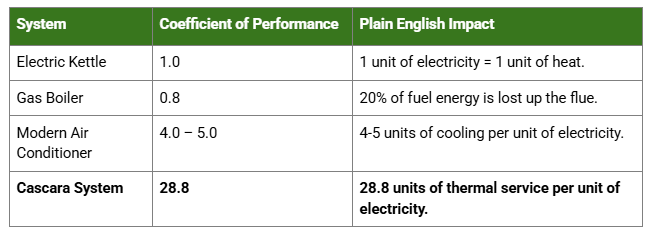
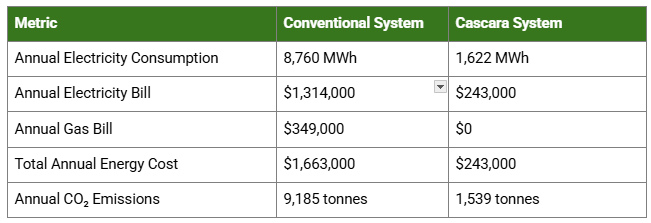
The Cascara system achieves this 28.8 standard by eliminating the largest source of peak-load electrical demand: the cooling compressor. Because the system utilizes a 91% electricity reduction for cooling, it operates for roughly 18 cents on the dollar compared to traditional energy expenditures. By harvesting waste heat from cooling to provide "free" heating, the system achieves unprecedented units of output from a single unit of input.
Infrastructure-as-a-Service
A major hurdle in decarbonization is the "split incentive" problem, where CAPEX constraints prevent long-term operational savings. Cascara bypasses this by utilizing an Infrastructure-as-a-Service (IaaS) model, essentially functioning as a private thermal utility.
Under the "Design, Build, Own, Operate" model, Cascara de-risks the transition for building owners:
Zero Upfront Cost: Cascara absorbs all CAPEX for the CO₂ backbone and installation.
Fixed-Rate OPEX: Owners sign energy contracts with rates fixed below current utility costs, converting volatile energy bills into predictable operating expenses.
Long-Term Stability: 15–20 year terms provide protection against natural gas price volatility and carbon tax escalations.
Before vs. After: Representative 1 MW Building
The Climate Case: Verification and Decarbonization
Buildings are historically "hard to abate" because they are tethered to legacy gas infrastructure. Cascara provides a path to complete gas disconnection, turning the transition into an economic gain.
7,645 Tonnes of CO₂ Eliminated
a single 1 MW installation removes the equivalent of 1,660 cars from the road every year.
Furthermore, this model offers a robust HFC Risk Management benefit. By utilizing CO₂ (GWP 1), assets are future-proofed against the Kigali Amendment's mandatory phase-outs of synthetic HFCs. As synthetic refrigerants become restricted and expensive, Cascara-equipped buildings avoid the looming "forced replacement" cycles and regulatory penalties facing traditional HVAC infrastructure.
Deployment and Scalability: From Subways to Resorts
The versatility of CO₂ thermal networks allows for infinite scalability within a district, as the two-pipe backbone can expand to any number of nodes across diverse urban topographies.
Urban Residential: Focused on high-density complexes with simultaneous cooling and hot water needs.
Active Project: Cascara manages a thermal system for a residential condo in Guelph, Ontario.
Transit Infrastructure: Providing cooling for deep underground stations without the need for large surface cooling towers.
Active Project: A pilot system for the New York City MTA is in development, utilizing compact CO₂ radiant cooling cassettes.
Hospitality Districts: Serving large campuses that require pool heating and room cooling simultaneously.
Active Project: A district-scale network is being advanced for a major resort in Cap Cana, Dominican Republic.
Industrial and Commercial: Recovering waste heat from data centers and food processing to redistribute across campuses.
Strategic Application: Leveraging the backbone to eliminate the net electricity consumption of industrial processes by harvesting "free" thermal energy.
Cascara’s strategic ambition is to own and operate the next generation of urban thermal infrastructure. With a pending international patent, Cascara is positioned to lead the transition to a low-carbon, high-efficiency future.
Website: www.cascaraenergy.com